This week’s lesson is going to really open your eyes big time.
But (please) don’t start reading or watching anything until you’ve selected a niche market, and done your competition research from Lesson 2.
Before you start — here are your Lesson’s Nuggets for today.
Print them out. Use them to guide you through the lesson. Follow along with our notes as you read, but also make your own. Keep all of these as a QRG (quick reference guide).
OK, let’s get started.
Firstly, we’ll run through the most important aspects to keep in mind when you’re looking to get to know your target audience (i.e. the theory part).
Then this lesson turns fully practical. We have a lot of snooping and digging around to do, you know — the “fly-on-the-wall” kinda’ stuff.
The point of this week’s lesson is to collect intel on our target customer. Next week, you’ll use that intel to build an actual persona (don’t worry about what this is yet).
So You Have a Niche, Now What?
You see … at this point “conventional training” teaches you to start with a product (a nice hot selling, high-gravity one). We explained this to you Lesson 1.
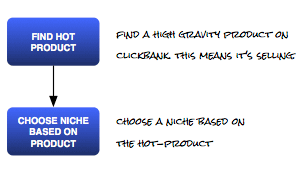
So because the product is already chosen … the logical next step (typically) is to throw up a knocked-off review page (enter 5-star glowing endorsement) or some BS presell.
Then swipe your competitor’s ads. Run traffic to it … and voila! — you have a business.
Buzzzzzzzz!
Wrong answer. Game over. Insert coin to continue.
99.99% of times (now in 2011) you’ll loose your shirt and your ass doing this. Insert Kleenex moment.
There’s strategical and tactical shit happening (invisibly) within the framework of a successful TLB. Stuff that spy tools can’t see or reverse-engineer.
MwaHaHahaHa!
Time to get real. Here’s how it should be done…
Truth is … it should’ve always been done like this. But no one did it, because in the past, it was a lot easier to just swipe (steal) what your competitor was doing. Knock him off.
Sad thing was that it worked like a charm. So no one even thought about doing stuff the right way.
Never even entered their minds. This was great for the gurus because they were the ones selling the shovels (the push-button swipe-someone’s-business super-duper software.
No magic David Copperfield software here, my friend. It’s all hard in-the-trenches grunt work at this point.
But at least it’s fun … we promise 🙂
So far you’re chosen a narrow or hyper-focused niche (customer segment) to focus on with your TLB. You also got to dig deep into what that niche holds in terms of competition and market conditions.
As an aside: A hyper-focused niche is going to have less reach than a narrow one … but your ability to more closely “talk to” and “match” your offer (value proposition) to what they are looking for — will be greatly increased.
Both are fine. Just avoid targeting at the mass-market niche level as it gets VERY hard to speak specifically to people’s pain-points (there are just so many of them).
Now you know your niche, the next step is to get a deep understanding of the actual people that are looking for a specific solution.
Your Ideal Target Customer (big picture)
At this point your job is to define who your ideal target customer is. We refer to this as a customer segment.
Notice you’re not defining your ideal prospect.
Again … we’re approaching this all backwards. We know it may seem a little counter-intuitive. Just trust us. It’ll make sense shortly.
You are choosing (defining) who you want as a customer.
Once you know that — it’s ten times easier to create situations that will attract the most important (best) people into your funnel. And conversely it’ll allow you to set up “filters” to weed out the people who you don’t want.
Do you remember our Andre & Steve Niche Market Golden Rule?
It’s always BETTER to go narrower than too wide … and then IGNORE EVERYONE ELSE!
This time it’s the ignore-everyone-else part that we’re talking about. And you can only ignore everyone else once you’ve defined exactly who you want as a customer.
The most important people to target in your chosen niche, are ones experiencing (massive) emotional pain (and are urgently and desperately looking for a solution to that pain point).
What’s their “profile”?
Who exactly are they and what exactly do they want?
Where do they hang out to talk about their ‘pain’?
What is their WHY (this is huge!)?
A WHY is a person’s deepest, most emotional/pressing/important reason for doing something. The WHY is one of the most powerful driving forces behind human behavior. It explains and justifies pretty much any action your prospect will take in the process of becoming a loyal long-term customer.
The why will give you the all important emotional triggers and hot-buttons that is their real motivation for seeking out a solution.
WHY is it that a bride-to-be would want to lose some weight before her big day?
WHY do people in the IM space want to learn how to make money?
In both cases it’s not simply to “lose weight” and “make money”.
These are just the surface outcomes they may desire. But it’s not the emotional reason why they’ll seek help.
Take Erin, for example … some of the emotional reasons why she’d want to look stunning (in her own mind) may be because she wants to have really great photos.
Photos which are a snapshot hard-coded in time. For family to see. For future offspring to see. Something special and amazing to look back at in 40 years time.
Perhaps she wants to be the best she’s ever been for her husband-to-be.
Maybe she’s let herself go a little … and she REALLY wants to fit into her mother’s size 6 wedding dress that has been passed down to her?
Notice the emotional reasons there … the deep WHY?
OK, time for a more detailed example of what we’re talking about. Here’s John’s story:
 John, a 56 year old guy wants to make money online because in his mind he needs to be the bread winner (very important for a man).
Yet he’s recently lost his $60K while-collar job as a Mortgage Lending Adviser at a local bank.
The bank was hit hard when the global economy tanked. Now due to “downsizing” he finds himself unemployed … and worse still, unemployable.
At $60,000/year the bank can hire two (and a half) twenty-nothing whippersnappers to do John’s job — plus they’ll jointly get 3 times as much work done as he ever could on his own.
In John’s mind he’s fucked. He has 3 kids. His 4yr old angel. A 12yr old. And a 17yr borderline genius who has her mind set on attending Massachusetts Institute of Technology.
To help cover the bills John’s wife, Jane, goes back to work. But because she’s 48, it’s not exactly easy to get employment either.
So she works two jobs. Does daycare during the day and does waitressing 3 times a week in the evenings.
John is stressed out. He feels that he’s let the team down.
Casey his 17yr bright-spark can’t stop talking about MIT. She’s already applied. John hasn’t broken her the news that one year at MIT is going to entirely wipe out the family savings coffers.
Of course, John won’t tell her. He’ll send her on her way to MIT with a big smile on his face…
… because John has a plan.
It’s a long shot — but it’s his only option as he sees it. He told Jane his master-plan. She doesn’t understand. But she can see that he’s a broken man. A shadow of his former happy-go-luck self.
So she relents and says … “OK John, but you have four months to prove that this crazy-idea of your will work.”
John has one last credit card with a $5K limit. Perfect.
Do you see all the emotion in that little story?
If you knew that story before hand … how easy do you think it would be to sell John an affiliate marketing product?
Time to go deep, baby! 🙂
Deep Target Audience Analysis
Remember we said earlier that this week is all about gathering data about your ideal target customer?
- What is it (exactly) that your ideal target customers wants to achieve?
- What problem are they trying to solve or what need are they trying to satisfy?
This goes back to uncovering their WHY.
Think need based. You should meet this need. Offer the potential to solve their problem. Relieve their pain. Satisfy their need.
You need the info you gather so that next week you can build your very own customer avatars.
What the hell is a customer avatar anyway?
Well … the short story about John above is the beginnings of an avatar that represents someone who you’ve identified as a candidate for your ideal target customer profile.
Typically you’ll need to create at least three (3) avatars to represent the most common characteristics of your ideal customer audience in your niche category.
Getting to this point requires some good ‘ol hard-nosed detective work.
This part is fun. But it also takes a fair bit of time. Don’t rush it. It’s way too important. This is the stuff that’ll make-or-break your campaign.
At a minimum (when you’re really good a doing this) it’ll take a few hours. But ultimately to complete this section — you’ll be in for a few days of research, analysis and “interviewing”.
Huh? Interviewing? But, but…
Keep your panties on. Don’t freak out. All will be explained later 🙂

Now we get our hands dirty. Here are some of the places/tools you can start with for your research.
Deep Analysis Tool #1: Demographics and Psychographics
You need to understand the demographics and psychographics of your audience to be able to effectively target them and get under their skin.
Knowing this will create the context for you to talk to and connect with your audience. Later down the line this research will also be massively useful for when you try and reach your audience with self-serve advertising.
Demographics are the “typical characteristics” of an audience (age, income, education, status, type of occupation, region of country, household size, etc) – the environmental/living characteristics that your customer moves/lives in.
Psychographics take this idea a step further. These include people’s lifestyles and behaviors — the psychological characteristics that shape your customer’s behavior.
It’s not an exact science — and you don’t necessarily need to nail down all this information. In many cases you just can’t (or don’t need to). But things like gender and age are pretty much a prerequisite.
We’ll stick to the theme of “weight loss for brides” here.
To determine demographic (and psychographic) data, we need to uncover places where “brides” hang out.
The obvious place to start our detective work would be sites that sell bridal gowns. Make sense, right?
A quick search on Google for bridal gowns, reveals these:
http://www.kleinfeldbridal.com/
http://www.maggiesottero.com/
http://www.davidsbridal.com/
http://www.houseofbrides.com/
http://www.paydress.com/
Because we ultimately want to target overweight brides — it’s worth looking at bridal sites that specifically target “plus size” brides.
A quick search revealed these:
http://www.plussizebridal.com/
http://www.igigi.com/
http://www.romanticgowns.com/collection/plus-size.asp
http://www.lightinthebox.com/wholesale-Plus-Size-Wedding-Dresses_c1914
We also noticed that JennyCraig.com has a section on brides that lost weight (this may come in handy later):
http://jennycraig.com/successstories/category/100006/
We’ll also look at the demographics of a mass-market bridal magazine:
http://www.brides.com/
http://twitter.com/brides
We use two main sites to determine demographics:
Google’s Display Planner:
https://support.google.com/adwords/answer/3278806
Quantcast:
http://www.quantcast.com/
Here’s the Ad Planner results for KleinfeldBridal.com (they claim to sell more designer bridal gowns than any other store on earth):

The 25-34 age group seems to be the largest segment.
Interests is more useful for later on when trying to target and reach these people with paid advertising:

Google also reveal other sites that this audience is more likely to frequent, too (useful info again):

In Ad Planner it’s worth creating a Media Plan. This way you can add multiple sites and then get the overall demographic profile of the audience — like this:

So we have our target age (25-34) and a few other useful tidbits.
Deep Analysis Tool #2: Amazon
Amazon is a pure goldmine for learning what people like and dislike about products (solutions). You get to see the language they use.
Their pain points (what really riles them up and what THEY care about most). A great tip here is to copy any phrases from the comments sections that you think you’ll be able to use later.
Head over to Amazon:
http://www.amazon.com/
Not everyone knows this … but Amazon has community discussions around products and categories on their marketplace.
Notice the “2 customer discussions” label next to the first product and one for the second one:

We also see a new audience category that hadn’t even crossed our mind before. Young ladies going to a prom. No doubt there’s prob’ly a lot of weight loss needs there. Interesting. Something to file away.
Browsing about Amazon can take hours. Hell … it’s quite possible to lose an entire day just inside Amazon.
This is normal. So don’t stress out about how long you end up withinAmazon.
A quick search revealed two books specifically targeting brides and weight loss:
- The Wedding Dress Diet
- Buff Brides: The Complete Guide to Getting in Shape and Looking Great for Your Wedding Day
Pay close attention to the 1, 2 and 3 star reviews. These are the best. The product didn’t deliver on its promise in some way — and you get to discover exactly what it was.
This is about uncovering pain points and hot-buttons (hint hint).


Amazon also reveals another bombshell under the heading — Customers Who Bought This Item Also Bought. I found these as a result:

… most of which have comments — so no doubt there’ll be some potentially good insights to discover.

See? 🙂
There are no rules here — just dig in and pay attention with your ideal target customer in mind. Copy and paste everything you feel may be relevant. Later on you can go over all your notes and clear out the stuff that’s redundant.
Deep Analysis Tool #3: Discussion Forums & Blogs
Forums are still some of the all time best places to “spy” on an audience.
It doesn’t matter if you’re targeting a mass-market niche like weight loss or make money … or a narrow hobby interest like Betta fish breeding(Siamese fighting fish).
Start with these two forum search engines:
… Google Communities is another great place to “spy”.
A quick search revealed that Brides.com has a forum … and in the forum is a Diet & Fitness category:
http://www.brides.com/forums/forum.jspa?forumID=44
It has (at time time of writing this) 778 threads and some 18,281 messages. The category has also been viewed 319,966 times. Not a bad find.
We’re after finding:
- specific “pre-wedding” issues
- specific language (like slang)
I didn’t have to look far. The very first message in the forum is a beauty:

… she’s looking for help with “arm flab”. That’s a very specific (emotional) problem. It’s a pain point. It’s a hot-button. She’s using specific language (arm flab). Pure gold!
It’s worth mentioning that you aren’t bothered about investigating what the solutions are for these problems. You simply want to know whatthese problems are.
Her actual forum post also reveals some great insight:

Insights:
- needs to lose 48 lbs in total
- self conscious about her arms
- needs to tone up her arms
- so they don’t look “flabby”
- because the dress is strapless
- has tried lifting weights but only seeing muscle
- desperate for a solution!
… and all these killer insights are just from the first post in the forum. Time spent as a “fly on the wall” in forums is a good investment.
This is how to write killer presell copy … by uncovering all these “emotional pain points” and then using (pushing) them. You’re effectively speaking your prospect’s language …
Blogs which have an active following are also a great place to flex your investigative private-eye skills.
Deep Analysis Tool #4: Facebook & Twitter
No mystery here … Facebook is the world’s largest online social playground. A place to hang out, lol and post pretty much anything to your “friends” or followers.
This activity creates a smorgasbord of niche-specific communications that can be studied from a distance. And you should do that, of course.
But Twitter is arguably an even better real time stream of niche specific communications.
Gary Vaynerchuk says that it is firmly his belief that one of the most powerful and important sites on the internet today — is search.twitter.com:
Where Twitter gets powerful (and where the opportunity is) is that YOU CAN LISTEN.
In fact, listen to what Gary has to say about Twitter … and why he thinks marketing is about to get “really fucking hard” (his words, not ours):
http://fora.tv/2010/11/05/Gary_Vaynerchuk_The_Thank_You_Economy#chapter_02
Interesting, no? It’s about to get really one-on-one. 🙂
Back to Twitter…
Look at these (any one will do):
http://search.twitter.com/search?q=Britney+Spears
http://search.twitter.com/search?q=Jenny+Craig
http://search.twitter.com/search?q=Gary+Vaynerchuk
http://search.twitter.com/search?q=Kelly+Brook
These are REAL TIME streams of communications between normal people. It doesn’t get more current and up-to-date than this.
search.twitter.com is a unique opportunity for your to tap into pretty much any conversation in any niche market on the planet.

Twitter has a special tag called a hashtag (the “#” symbols). Hashtags are used to mark keywords or topics in a “tweet”. In a nutshell — it helps you find interesting tweets.
Clicking on a hashtaged word in any message shows you ALL other tweets in that category. This is so cool!
For example, here’s the hashtag for the 2011 budget (#budget2011):
http://search.twitter.com/search?q=%23budget2011
You’ve now just tapped into a live real time communications feed where anytime with a Twitter account can make a comment (a tweet) … and YOU GET TO LISTEN IN.
Find all the best most relevant hashtags for your niche market — and you’ll have the ability to stay on top of all the current news and topics. It’s insane how powerful this is.
It’s worth mentioning though — that yes, you’ll see a lot of irrelevant “tweets” (aka: spam) … especial around commercial topics. It’s a small drawback. Just filter out that crap and focus on what matters to you.
Great article on Mashable about getting the most out of hashtags:
http://mashable.com/2009/05/17/twitter-hashtags/
It’s also interesting to observe trends in Twitter:
http://trendistic.com/
The past couple of weeks there has been a bunch of activity about whether Skype is going to be acquired by Facebook or Microsoft … as you can see by the Twitter spike:

Same when (sadly) Kelly Brook was reported to have lost her baby girl at nearly five months due to a miscarriage:

Point is — using search.twitter.com to tap into trends is a powerful way to remain “in-the-loop” about niche specific news.
UPDATE: Here’s a Twitter search query that attempts to toss out the spam (excluding links: http, www, and com). Includes questions like “how” or “what” about a particular subject: for example “weight loss”.
http://twitter.com/search/-http%20-www%20-com%20how|what%20%22weight%20loss%22
Thanks to David Wooding for sharing this with us in the comments section below.
Deep Analysis Tool #5: Interviews
This strategy will give you the most customer insights than any other.
For example … we want to sell a rapid weight loss solution to the brides-to-be so that they can drop up to 20 lbs within 30 days of the run up to their big day.
Using Ad Planner and Amazon and forums is great. But you’re still just a fly on the wall. You’re somewhat limited to how deep you can go into really understanding your audience.
When you get to speak to someone on the phone or in person about them and their previous problems (and how they overcame those problems) you’ll get to discover stuff that just can’t be found on public websites.
This step is of course not a prerequisite … but we certainly do highly recommend it.
The interview can just be exploratory. You pay them for their time. In return you get to ask them any Qs.
But the funny thing with talking to and connecting with people live is that you’ll find that some people really open up. In these cases there’ll be a very real opportunity to extent the relationship.
In the past I’ve asked if I could use the interview as part of my content (can make for a great bonus).
But where an interview can become very powerful (for you) is if the interviewee allows you to feature them on your presell (of course, real names can be changed for privacy).
All too many marketers pull presell (and email) stories right out their asses (excuse the French). There’s not one ounce of truth to their story. Nothing. It’s 100% science-fiction.
… and then they wonder why their message isn’t producing any sales.
We’ll cover this in detail in the presell section … but just know this — the “B.S. Radar” of your audience is dramatically better then you think.
Write a B.S. story promoting a product and it’ll come back to bite you on the ass. Hard. You’ll make no sales. Simple.
Which is why there is so much benefit in doing a real interview with a real person who’s experienced real emotional pain … and ideally, has achieved real results too.
Believe me … you can’t “feel” the real emotions of people (for the most part) by just reading words on a forum or on Facebook. It’s not the same.
Speak to someone on the phone and allow them to express themselves in their own words — and it’ll blow you freakin’ mind.
If it’s a real emotional issue — you’ll FEEL those emotions in your gut.
Get permission to use their story (not necessary verbatim — you’ll no doubt need to “Hollywood” it a little) and you’ll have a message that’ll connect with your audience like nothing else.
Some ways of setting up an interview:
- Interview someone you know that has experienced the pain (and the desperate need for a solution) of a problem which you plan to offer a solution for.Ideally you’ll want to interview a few people. Not just one person. This way you’ll get a truer reflection of your largest (or more important) audience segment.
- Forums. Two ways to play this.
- Find someone desperately asking for help. PM them using the forum. Be honest with them. Tell them you’re researching various solutions for the problem she’s having.Ask whether they would be willing to do a 20 minute interview with you about it. Suggest to pay (or offer some sort of reciprocation that is of value to them).
- Find someone who’s (finally) experienced relief from the problem. They’ve achieved a real result. Same as before.Connect with them privately and ask whether they would be up for an interview. Suggest to pay.
- Post an ad on Craigslist asking for interviewees to come forward for money. We’ve not tried this ourselves (yet). But we know of people who have — with decent results. If we had to rate the above three points in order of priority (effectiveness), if would be:
- Forum (live) interview
- Friend or family interview
- Craigslist interview
Your task this week is to do the things we spoke about now. Use all the tools we mentioned above.
Be creative. There are no rules of how much data you collect, and how you choose to store it.
All you have to keep in mind is the need to get to know your target customer audience so deeply that you can FEEL their pain.
HEAR what they hear.
SEE what they see.
SAY what they say and HOW they say it.
All relevant to their pain-points and the solution they are looking for.
Here is the sheet with your Lesson Nuggets:
- Lesson 3 Nuggets
(Right-Click and select Save As…) - PDF of all lesson comments
But first — hear what Steve has to say in the video below. More nuggets …
INSERT VIDEO