This lesson is going to put to use all the detective work we’ve been doing over the past 2 weeks.
Needless to say, if you haven’t done the detective work, stop reading right now and go do your homework. Only by getting your tasks done on time will you get to benefit from what we teach in each lesson.
Today’s lesson is mostly practical. There are a few videos that we’ll share with you as well. So let’s get right into it.
Before you start — here are your Lesson’s Nuggets for today.Print them out. Use them to guide you through the lesson. Follow along with our notes as you read, but also make your own. Keep all of these as a QRG (quick reference guide).
Look at your progression so far:
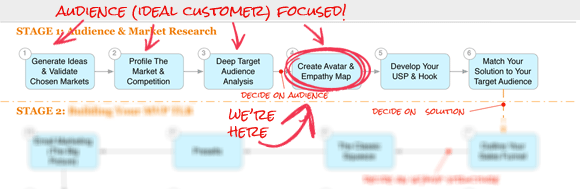
Notice how everything is customer focused. The actual product you choose to promote at the end of the day — is totally irrelevant at this point.
It’s all about:
- Choosing a customer that YOU would like to do business with…
- Figuring out (specifically) what it is that THEY want to achieve(the desired end result from their perspective)…
- Digging so deep that you discover and can FEEL their pain and EMPATHIZE with them. What is the desperate emotional need they’re looking to satisfy? What is their WHY?
… and only then can you (effectively) deliver value by promoting a product as a potential solution (a tight fit) to their problem/need/pain/urgency/result etc.
A solution you know will help them. It’s important not to lose focus of the fact that you’re giving a real tangible result to those people.
So this week we get to conclude your deep grueling research into the heads of your ideal target audience, by creating a Customer Avatar (CA) and an Empathy Map (EM) of 1 to 3 (ideally 3) people that represent the main characteristics and traits of your audience as a whole.
Most of the grunt work you’ve already done. This task will “tie up” everything you’ve learned so far about your audience.
Create Your Ideal Target Customer Avatar
What is a Customer Avatar?
We’ve created two (real) examples below for you. But essentially it’s this…
It’s a narrative that creates “context” about the (real) thoughts, concerns, intentions, mindset, and NEEDS of your target audience (as a whole).
It’s where you can get to feel the EMOTIONS of your audience.
There is absolutely no way you can effectively connect with your target audience without first understanding and identifying exactly what they are going through.
… as in the “story” that they are telling themselves.
This should be done using facts collected through real research, not just “made-up” guesswork sitting at your office desk. Many marketers fall short right here.
Why Use (create) an Avatar?
Well … once you have one (ideally 3), you use it to REPRESENT your ENTIRE audience.
Your ads, your copy … EVERYTHING — get’s written as if you’re talking to (marketing to) that one person — your actual avatar(s).
Read the two avatar examples below. Once you do that, you’ll see how much easier (clearer) it would become to market to them.
The internet is a massive “invisible” (impersonal) place.
On a forum or a blog, you can only read what people are saying. You need to fill-in-the-blanks yourself — in terms of the conversation in their head. FEELING the emotions they are experiencing.
Most marketers fall to pieces here. They don’t have the ability to really empathize with virtual people.
Contrast this with speaking to someone in person…
You meet the SAME person that posted to a forum or blog. But they’re in front of you now.
You can SEE their face. You can SEE the emotion in their eyes (eyes don’t lie). You can hear their voice. The intonation. The fluctuation in what they’re saying when something emotional hits them hard.
Crafting a marketing piece for them would be easy. The hot-buttons, the pressure points … you’ll know them all already.
You would have FELT what they are feeling … so translating that into words on a page would be 10 times easier (and more effective!).
Creating avatars bridges this gap. It creates something real and tangible from something virtual.
93% of communication between two human beings happens on a non-verbal level (body language — body posture, gestures, facial expressions, and eye movements).
7% of communication consists of words themselves.
By creating an avatar, and an Empathy Map you’re effectively filling the missing chunk of having a near 100% relationship with your audience.
The GOAL of an Avatar?
We said it in the paragraph above. It creates something real and tangible from something virtual.
It allows your marketing to be exponentially more IMPACTFUL. You get to “talk to” someone real.
How to Create Your Own Avatars …
It starts with research, of course. You’ve already done most of this.
You then take all the FACTS about your target audience…
Demographics (statistical data related to this group of people — such as race, age, gender, income, mobility, etc).
Psychographics (the study and classification of people according to their attributes, aspirations, and other psychological criteria — such as personality, values, attitudes, interests, lifestyles, social class, behavior, needs, wants, desires, etc).
… along with all the forum, blog, Amazon comments, etc — and group them into common traits.
For our “bridal” niche, the MOST COMMON age range was: 25-44
So you may create three avatars: a 26/yo, 34/yo and a 42/yo. The names you give them can, of course, be made up. But give them names — because it makes them more real.
You should even put a face to the names (like we’ve done in the two examples).
If you, for example, decide to really niche down — you may decide right up front that you want to focus on young (pre-30) brides.
… or conversely, post-40/yo brides.
How you position and slice-and-dice what you do, is totally up to you.
HINT: You may find it easier to FIRST do the Empathy Map exercise (also below). Then using your empathy maps, “built-out” an avatar story to create context for your avatar character.
It’s worth mentioning that the actual FACTS that make up your avatar need to be 100% accurate based on your real research.
But the “story” that wraps around those facts can be fiction.
For example, your post-40 bridal research may have revealed that the majority of your audience has young kids (FACT).
So your avatar profile could say:
“Emily is 44, and has two kids. Kim is 6, and Tom is 12…”
… see how that works?
The two kids (their ages and names) are FICTIONAL. Emily’s name is FICTION too, but her age is based on REAL demographic data. As is the FACT that the MAJORITY of post-40 brides have kids.
Make sense? Cool.
To demonstrate and put into action all of what we’ve said here — we’ve created two avatars for your benefit.
This is a result from us doing some real life deep ideal audience research (brides looking to lose weight before the big day):
 Erin is 26. She’s a full time HR Manager for a busy tech company in New York.Erin is a go getter, she’s not afraid to get stuck into whatever is required to get her team working like a well oiled machine.
Unfortunately, success and full time dedication to her young career has given her a few extra pounds around her thighs and mid section. This she sees as a problem.
It’s a problem because her boyfriend of 2 years has just proposed to her. That was 5 months ago.
Erin had fully intended to be very dedicated, and to start eating properly and exercise regularly to lose the extra weight.
But as it usually happens, life just keeps going and somehow, before she knew it, there’s just a little over 30 days left to her big day!!!
It’s panic stations for her now. She needs a solution that works. And it HAS to work in 30 days or less.
You see, Erin comes from a loving family. She’s been raised to value her parents, and has always dreamed of having a big family wedding — her granny, her mom, her dad and siblings — they’ll all be there.
Ever since she was a little girl Erin’s dream was to wear her mom’s wedding dress at her own wedding. It’s stunning — white lace and satin.
She’s the only girl in the family, so she knows it’ll also mean a lot for her mom if she wears it.
The BIG problem threatening to spoil the whole dream is — Erin’s 15 lbs too big for the dress…
So there’s only one solution: she HAS to lose the weight! Fast!
She ‘s a go-getter, so she gets into action right away. She’s internet savvy. Doesn’t lack money. Her job pays her well. She’s also smart!
Her being overweight isn’t because she doesn’t know what to do to stay slim. She just never seems to have the time to fit meal prep and workouts into her day.
She also knows the value of good preparation. So she tackles this as a normal work project.
Gets online. Looks for an all-in-one solution for fast fat loss. She doesn’t just want the diet.
She wants a workout blueprint of what the best exercises are for fat loss and what supplements she needs to take to make sure that she’s losing weight fast, but also healthily — there’s no point in going through all this and feeling like a walking corpse at the end of it.
Just to make sure she has the right solution (no time for experiments), she’ll also ask all her Facebook buddies about what they can recommend.
Final action step for her — Tiff — her best friend is a fitness instructor. Once she’s got the info off the internet, Erin will book Tiff for one-on-one sessions to make sure she kicks ass with her training.
Erin is savvy — she can spot a ‘stinker’ from a mile. She also has the trust, expertise and support of her network, so she is very likely to succeed.
This makes her a very valuable asset to have. Not only is she likely to make multiple purchases but she’s likely to be the one spreading the news if she is successful at her weight loss.
Her WHY: she has only one prerequisite for her wedding day (other than the groom of course) she MUST wear her mom’s wedding dress! Fitting into that dress is a powerful emotional reason for her to seek out our product.
Her FEAR: having the wedding of her dreams ruined because she can’t fit into her dress, because there’s little time left to lose the weight.
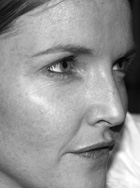
Jackie is 34. She has a little 7 year old daughter Julie, who’s the light of her life.
Jackie’s never been married. But she lives with Julie’s dad, Simon. Marriage had never been a priority for them. That’s why Jackie was shocked when Simon got down on one knee a couple of weeks ago.
They decided to do a small ceremony. Both didn’t want to wait long — after all Jackie’s been waiting for almost a decade. So the date was set — a month from now.
Jackie has always looked after what she ate. But the years of being a mom had piled on a few extra lbs on her hips and around her stomach.
She looked at herself in the mirror one night after taking a shower, and freaked out! She had to lose at least 10lbs. She HAD to find a way to do it — even though she’s only got a month.
She knew it will be drastic — but she was prepared to push herself — because this was her moment. Although she’d never pushed Simon into proposing, she, just like every little girl out there had dreamed of her ‘big day’ over and over.
Now that her little girl was by her side too, she was doubly determined to make it a stunning occasion.
So it was clear — she’ll get on the computer tomorrow morning and find a solution. She frequents a few mommy’s forums, and is an affluent Facebooker.
Her network of always-dieting-moms are bound to have some tips as to what program she should get.
For her — it has to work well. It has to produce results fast. It has to allow her to fit everything in her schedule as a mom and a partner. She needs to know that she’ll drop the weight off her hips and tummy.
And most importantly, it has to be healthy. She can’t afford to set bad examples for her daughter!
She’s computer savvy — and loves videos and audio books. She is 34 so she knows by now what she likes and dislikes in life.
Her WHY: This is her ‘big day’. She’s always dreamed of it although she’d been close to giving up on it ever happening.
She has a specific dress in mind, but it’s very hugging on the hips and abs, so she has to have those in the best shape possible. That, combined with Jackie’s determination to set a good example for her daughter are her driving force.
Her FEAR: She fears she won’t have enough time to lose the 10 lbs that are bothering her in the 30 days she has left. She fears that the diet she picks will not deliver what it promises.
Create Your Ideal Target Customer Empathy Map
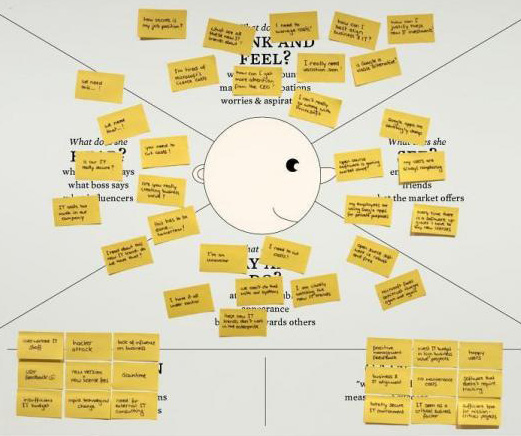
What’s an Empathy Map?
It’s a map of someone else’s point-of-view (POV). What do THEY see, say, think, feel and hear. It’s THEIR perspective. THEIR world view. THEIR emotions. THEIR beliefs.
You create (populate) an Empathy Map by observing four core customer traits.
Ideally this “game” is done (played out) in a group. If you have a team, this should be done with them — altogether.
If you’re a one-man-band, you can do this solo too. It’ll work fine — but you’ll have to work a little harder to make sure your empathy map represents real (unbiased) traits that aren’t “skewed” by your own personal beliefs and/or ego.
Why Use (create) an Empathy Map?
It’ll allow you to represent your customer avatars in another way. An empathy map is another tool to help you “synthesize” your observations of your audience and draw out (potentially) unexpected insights.
The GOAL of an Empathy Map?
The goal of the “game” is to gain a deeper level of understanding of your customer, within a given context — such as a buying decision or an experience using a product or service.
The exercise can be as simple or complex as you want to make it.
You should be able to make a rough empathy map in about 20 minutes. Provided you have a decent understanding of the person and context you want to map.
Even if you don’t understand your audience very well (although by this point you should) — the empathy mapping exercise can help you identify gaps in your knowledge and help you gain a deeper understanding of the points you’re missing.
Here’s How You Create Your Own Empathy Map
STEP 1: Download this empathy map template and print it out (compliments of xplane.com)
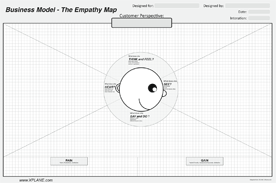
Download Empathy Map Template
(Right-Click and select Save As…)
STEP 2: Start by choosing one of the Avatars you created earlier (you’ll create an Empathy Map (EM) for him/her first).
They should already have a name. Write that in the EM, and also add some more identifying information — such as a job title.
If you find it helpful, fill in some extra details … like perhaps glasses if appropriate or a hairstyle to differentiate the person from other profiles you might want to create.
These simple details are not a frivolous addition — they will help you project yourself into the experience (point-of-view) of that person, which is the whole point of the exercise in the first place.
Incidentally, that’s why we added a pic for each of our avatar examples — it makes them a lot more ‘real life’ than just a bunch of words on a page.
STEP 3: You’ll notice that the empathy map is divided into four quadrants:
- THINK & FEEL?
- SEE?
- SAY & DO?
- HEAR?
Based on all the intel you’ve collected over the past few lessons, and the Avatar you created earlier, start working your way through the quadrants.
Write down as many answers as you can think of. There’s no such thing as too much info here. Just make sure anything you write is related to the problem your Avatar is trying to solve.
For e.g. — our bride-to-be who’s trying to lose weight fast in time for her wedding: What does she THINK & FEEL?
If you find yourself ‘stuck’ for answers, try to determine a question you have for this person.
One of my first real mentors in this business was a guy named Roy Montero. This was back in 2003 and 4. He taught me SEO. I learned a valuable lesson from Roy, which I’ve never forgotten.
Whenever I asked him a question — instead of just giving me the answer, he would pose another question to make me think of the answer myself. The process was enlightening.
Do the same here.
If you had a question you would want to ask your ideal customer — or a situation in their life you want to understand — what would that be?
You might want to understand a certain kind of buying decision, in which case your question might be — “Why should I buy X?” (notice the first-person)
This will help you to populate your empathy map.
Now, as best you can, try to PROJECT yourself into that person’s experience and understand the context you want to explore.
Then start to fill in the diagram with real, tangible, sensory experiences.
What’s Your Customer’s POV?
Stanford University teach their design school students to use point-of-view (POV) to build empathy map profiles of target audiences (customers).
Here are some really cool examples of people being “interviewed” so that THEIR POV can be “extracted” and profiled.
Truck Owner POV:
Mechanic POV:
You couldn’t make this stuff up. These insights are priceless.
Embrace: Defining a Point of View:
Here are some of the reflections of the students as a result of “design thinking”…
Student Reflection:
Watch this video. It’ll demonstrate empathy in action. Notice the (initial) different perspectives. Then notice how that perspective suddenly changed once “empathy” was factored in…
Sparrow Empathy Clip:
In this video (right-click to download: 47MB) people give blood … and then they give THEIR reasons WHY. It demonstrates the power of why going into the field to do “needfinding” is so insightful.
Then in this video (again, you’ll need to download it: 11MB) you get to hear a guy rationalize his thoughts WHY he does a long commute each day.
How to Conduct an Interview
One of the best ways to get an understanding of your customer’s mindset is to speak to her/him directly. I.e. to interview them.
You can do the “fly-on-the-wall” research and spend days in forums, but speaking directly to your target audience will give you insights you just can’t get anywhere else.
It may be scary to even contemplate an interview, but the minor discomfort is worth it, for the golden nuggets you’ll get out of the experience.
To demonstrate this process, we approached a friend of ours. He wants to lose 100lbs in 6 months — so was the perfect person to interview for the purpose of “insight” (and empathy).
Based on an interview preparation methodology from the Institute of Design at Stanford — Anita (she operates behind the scenes here at TLB HQ) conducted background research on our “subject”.
SIDE NOTE: The above document is excellent in setting the scene for you. So we’d like to add a few notes to it to help you get even more out of your interviews:
- look for emotional triggers
- if something seems to trigger extreme emotion in your interviewee, dig a little deeper (tactfully of course). Sometimes even they will not suspect what lies beneath…
- pay attention to the exact phrases your interviewee uses
- pay attention as your “subject” responds. If he answers two/three of your questions at the same time, note that down.The next question you ask should pick up from where he left off. Unless you need a clarification.
- your empathy map is the desired outcome of information for this interview – so use it to backwards engineer your questions.
- follow all the advice in Stanford’s interview for empathy process outline.
So here is the background of our interview.
- We chose our niche market to be business owners working from home, who want to get healthy and/or lose weight.
- Justin fits that target audience profile perfectly.
- Anita’s background research (without doing any creepy digging), revealed the following specific info about him.This helped her to fine-tune her questions specifically for Justin’s context.Not asking redundant questions, helps keep your “subject” focused, and avoids irritating them or making them distrust you.
- Justin is 29 y/o
- He’s married with young kids.
- Works from home (in Florida — sunny, holiday/retirement minded state)
- Wants to lose 100lbs in 6 months.
- Other extra facts:
- He’s set himself a specific challenge.
- He’s gone public — Facebook — so he’s determined to succeed.
- He is above average internet-savvy.
- Has disposable income (6-figure online business).
- Is used to self discipline (working for himself).
- Has already chosen a method for his challenge (raw food diet/method of eating).
- From all the info we have about how Justin has approached this challenge, we can conclude that he is determined and willing to put in the hard work.
- The objective of this interview: to find out enough about Justin to allow us to build a detailed empathy map to help us understand how to best help him achieve his goal.
- Leave your own convictions behind: what you think about the problem your “subject” is having and how he/she should solve it is irrelevant right now.In fact it’s essential that once you start talking to the person you remove ALL personal and expert bias.If you don’t you’re likely to be more suggestive and you might distort the responses you get. This makes your interview (and of course the data you collect) misleading.
Our interview will take this shape:
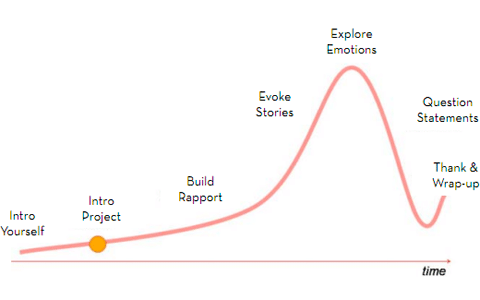
And here is how it went:
Intro Yourself
Hi Justin, my name is Anita Chaperon. I own a blog called Fit Happy Healthy, through which I aim to help business owners who work from home to lose weight and embrace a healthy lifestyle effectively.
Intro Project
I’m thinking of creating a specific structured solution (a course) to help my tribe do exactly that in the fastest and most effective way possible for them.
Build Rapport
Thank you so much for letting me interview you.
I can see you mean business as you’ve already gone public with your challenge through your FB page and on your dedicated blog:
BadCalorie.com
I can’t wait to discover where you find your internal strength from and so on.
Should we start with the questions?
Interview Stage: Evoke Stories / Explore Emotions / Question Statements
1. Describe a day in the life of Justin before you made the decision to get healthy.
2. What made you decide to change how you eat? (be specific)
3. Why does that matter to you? (dig for the Powerhouse WHY)
4. What would happen if you didn’t make the change?(Justin’s Fear/Pain?)
5. What do you want to achieve?
— Your goals, specifically? I know you said 100lbs in 6 months, can you be more specific?
6. How did you go about starting?
— What action did you take first?
— Where did you look?
— Did you ask friends?
7. How did you decide on what plan to use? Why raw?
8. How is the raw eating plan fitting in your family life?
— And travel?
— What about your social life?
9. Describe a day in the life of Justin now.
10. What would you say are the most challenging things about getting healthy?
— Specifically about eating raw?
11. What do you wish you could have at the start or now to make things easier/better/more effective for you?
12. Do you have any tips you would give other business owners like you who are about to start to live healthy?
13. Describe a day in the life of Justin — 6 months from now when you’ve achieved your 100lbs weight loss goal:
— How do you look?
— How do you feel physically?
— How do you feel mentally?
— How does your family look?
— How has that affected your business if at all?
— How is your social life?
14. Do you have any other insight/tips you would like to share with me about your experience so far? Or anything you may have gleaned from doing this interview?
At the end of the interview I asked Justin a few extra Qs. I was digging for triggers words.
Thank You & Wrap-Up
It’s been great to talk to you Justin. You’ve given me a lot of insights to take away and work with.
Thank you once again for your time.
I have your email and will send you your complementary copy of the product as soon as it is launched (or whatever incentive was promised for their time).
NOTE: Some of the questions above don’t have a separate answer to download.
That’s because Justin sometimes answered a few questions at once. It’s important to pay attention to your interviewee and to flexibly adjust your interviewing style.
This will ensure you get the information you need, and allows your “subject” to keep up with his emotions and story.
We hope you can see how powerful this method of gathering emotional intelligence about your audience is.
Do at least one of these interviews per target customer segment. Ideally do 3. Even better — do them periodically.
Your audience isn’t a stationary object. They evolve, learn, grow. They move, so do their opinions (POV) and worldview.
Find someone that fits your target audience and setup an interview.
Be specific about what you want to do. Offer them an intensive (money works great) to give you their time.
If you don’t feel comfortable being the interviewer, hire someone to do it for you (like oDesk or Elance)
This technique will open your eyes.
Examples of Our Empathy Maps
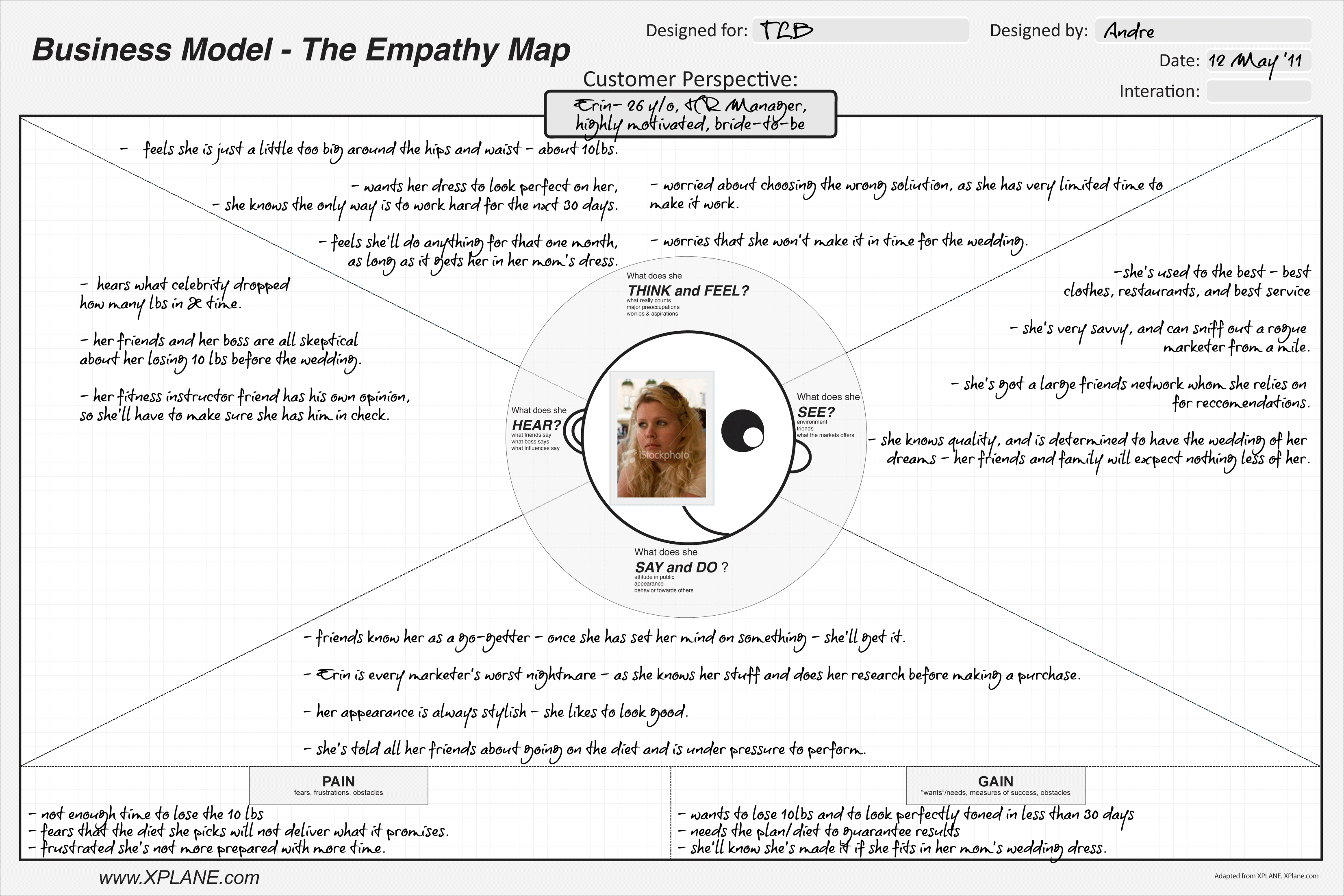
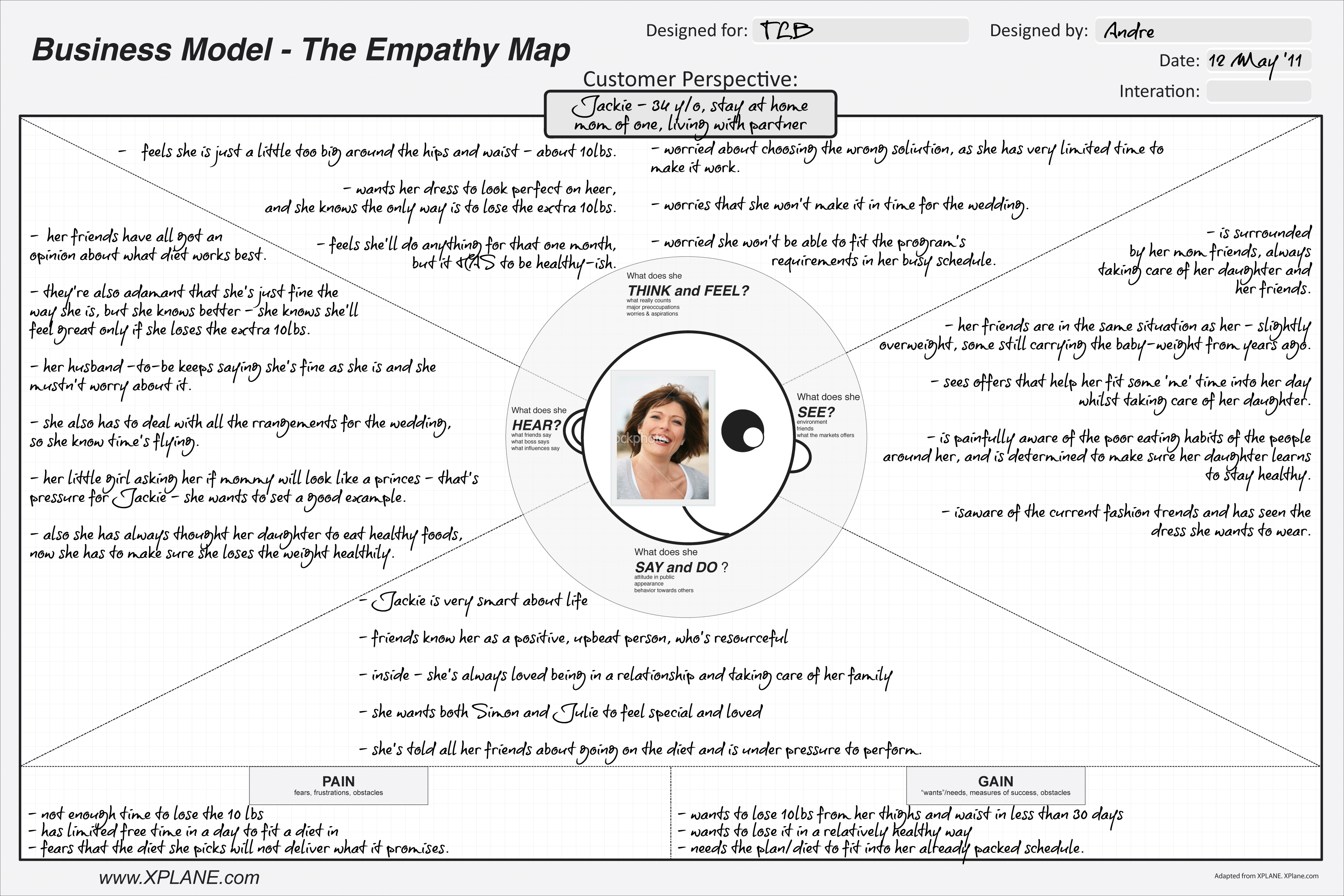
To demonstrate using real examples of empathy maps, we’ve created two maps for the weight loss for brides niche:
Erin, 26y/o, HR Manager (bride-to-be):
Jackie, 34y/o, Stay-at-home Mom (bride-to-be):
Serious Games for Market Research
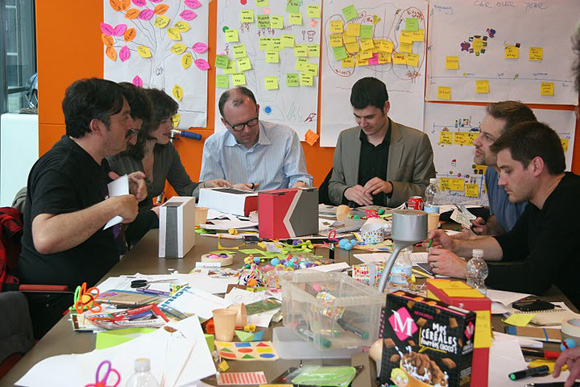
If you have a team as part of your company — then InnovationGames.com have created a great online empathy map creation tool (totally free). What’s really powerful is that multiple peeps can all add to the map in real time. Really sweet!
You can play the game here. Enjoy!
- Watch ALL the videos we share with you in the lesson. Really understand why you need to create an Avatar and Empathy Map for each one of your ideal target audience characters.
- Create 1 — 3 target customer Avatars (to represent the most common character traits in your chosen niche).
- Create an Empathy Map for each Avatar you created in part 2.
- We want to know how you’re doing. So don’t miss this opportunity to make yourself heard by taking our short survey here.
And finally, here are your Nuggets for this lesson:
- Lesson 4 Nuggets
(Right-Click and select Save As…) - PDF of all lesson comments