Before you start — here are your Lesson’s Nuggets for today.
Print them out. Use them to guide you through the lesson. Follow along with our notes as you read, but also make your own notes. Keep all of these as a QRG (quick reference guide).
Start With the BIG 3 …
Let’s talk about niche markets (also referred to as verticals).
Before we continue … we want to show you what the typical “conventional teaching” looks like:
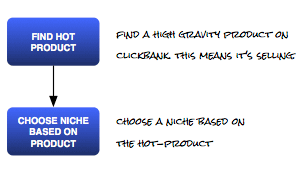
You should recognize it. It’s how you’ve traditionally been taught to find products to promote.
It’s a flawed process though (we’ll demonstrate why shortly). No wonder the majority of peeps don’t make one red cent. You’ve lost before you’ve even started.
Here’s our workflow:
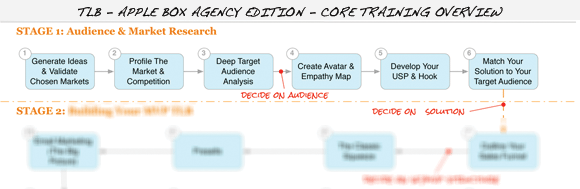
(Right-Click to download a hi-res version.)
Just a little different, no? 🙂
This week we’ll be teaching you niche market research and selection.
Next week we’ll address the parts that come before you can choose a product to promote. These parts (lessons 2 through 5) are required and very important.
Product selection for us comes LAST (why this is the case will become clearer shortly). All the training you’ve been exposed to prob’ly teaches product selection right up front. Tsk tsk…
Let’s start.
We refer to a “market” as something that is big, broad and general. No one targets an entire “market” per se (unless you’re perhaps Walmart).
As an example, you could think of “health and fitness” as a market. It’s broad and general. It’s way too broad a topic to be able to effectively target in one fell swoop.
Instead … we target smaller (narrower) segments or categories of people within a broader market. It’s these vertical segments or categories that we refer to as “niche markets”.
It’s in these “niche markets” where the battle is fought for the attention and mindshare of a potential customer.
From now onwards whenever we refer to a “niche market” (or just niche for short), we’re referring to a narrow and specific category within a market.
Later on, in this training, we’ll teach you an advanced strategy of how to use positioning to create a new niche category in the mind of your target audience.
The benefit of doing this is that you eliminate the competition. You essentially CONTROL the show. And because you’re the first one — in the mind of your target audience — you “own” this category.
Apple did this with the iPad. The whole tablet category really wasn’t defined and hence didn’t exist before Apple launched the iPad (even though other companies were selling tablets way before the iPad came out).
They created a new category. The result — no competition.
Apple has sold a whopping 360 million iPads since the original debuted in 2010. These sales figures include the original 9.7-inch iPad and the 7.9-inch iPad Mini, which was introduced in 2012. The original iPad sold 3.27 million units in its first quarter and was deemed a whopping success!
But more about positioning later. We need to teach you how to walk before we can teach you to run.
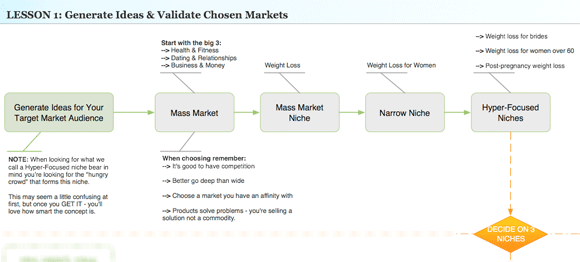
Let’s explore niche markers a little more. You need to (really) understand this part before you can even start to think about targeting a niche.
- Mass Market
- Health and Fitness
- General Mass Market Niche
- Weight Loss
- Narrow Niche
- Weight Loss for Women
- Weight Loss for Men
- Weight Loss for Teenagers
- Weight Loss for Diabetics
- Hyper-Focused Niche
- weight loss for brides
- weight loss for women over 60
- post-pregnancy weight loss
- weight loss for diabetic women
- weight loss for women who need to lose more than 50 lbs
See how that works?
As you move from left to right:
Market > General (Mass-Market) Niche > Narrow Niche > Hyper-Focused Niche
… your audience reach decreases — but your ability to really zero-in and understand the specific wants, needs, fears, frustrations, and challenges of an audience, is greatly increased.
The more specific and narrow your target — the better your ability will be to target, “talk to” and connect with an audience when we start posting on social media, the websites and even print material.
The BIG mistake that most marketers and companies make, is to target an audience that is way too wide. Too broad. They try to please everyone.
The result of doing that is a message that resonates and connects with no one. You’ll alienate your best customers. Not smart.
So make sure you always remember this (call it our Andre & Steve Niche Market Golden Rule)…
It’s always BETTER to go more narrow than too wide … and then IGNORE EVERYONE ELSE!
Got it?
Now just to screw with your mind a bit more — we’re going to give you a massive shortcut. This is a mega-tip.
There are three main markets that control 80-90% of all the traffic and movement of money online. We refer to them as THE BIG THREE. Our suggestion … stick to one of these exclusively.
Here they are:
- Health & Fitness
- Dating & Relationships
- Business & Money
Obviously — within each of the BIG THREE markets — there are hundreds, even thousands, of niches.
Your ability to understand the wants and needs of a market — will determine how well you can find niches within it to target.
Some of these niches may already exist (this is typically the case). Other times you’ll create a niche category yourself (this can be very profitable, but not so common, or easy).
Generate Ideas For Your Target Market Audience
Competition … She’s Good!
In the old days — when it was far less congested and competitive online — it was possible to “skim the cream” off the top of multiple markets and niches.
10, 20 … even 100 live campaigns at any one time.
Creating a campaign that produced a profit was relatively easy. You didn’t need to be a ninja. You didn’t need a deep understanding of military knowledge and business strategy.
You didn’t need to play war-gaming to outmaneuver the competition. No need for game-storming to generate new ideas, insights, and strategies.
None of that advanced stuff.
Things were simple in the wild west days of 2003-2007. Buy traffic. Directly link it to an offer. Or create a quick ugly no-value “review style” bridge-page.
It was great. You didn’t need to know squat about the niche market or the target audience.
Just throw $500 at AdWords or MSN or YSM … swipe someone else’s ad copy … fling it at an offer … and BAM — $1,000 to $4,000 in affiliate commissions.
At the end of 2007, we introduced a friend to this online marketing game. He didn’t know a freakin’ thing about anything to do with making money online.
Yet his very first campaign (and he did nothing ninja) was a $500/day (profit) success.
Success: 100%
Failure: 0%
… It was almost too easy.
But, to put this into perspective: if he did now what he did then, he’d not only make no money — but he’d more than likely get his AdWords account banned.
But he adapted. He was lucky (smart).
However, the cruel reality of 2010 / 2011 has left a very different landscape now. The people with yesterday’s lazy mindset are finding it impossible to make any money today.
Even many of the 800-pound gorilla “gurus” have moved out of Dodge.
When the “launch formula” stopped working for them — the writing was on the wall. Either innovate and add real value to the marketplace … or leave. Most have left.
Ever watched the movie, The Book of Eli with Denzel Washington?
… Well that’s what the online marketing wasteland looks like now. The easy ride is over. To play — insert coin, and get ready to hustle. Get ready to get very dirty.
Before you get too despondent … know this.
There are two ways to look at any situation. You’re either a glass-half-full kinda person … or a glass-half-empty kinda person.
When the competition gets amped up … the former rub their hands together with glee because they know that competition is a good thing.
That competition is a marker of a thriving free-market. And that dog-eat-dog competition will frighten the bejesus out of most of the glass-half-empty people.
The latter peeps may dip their toe in to feel the temperature of the water … and lose it very quickly. Nine toes left.
The adventurous may wade into the shallows where they think it’s still safe to play. But the screaming soon starts (ever watched Jaws? … you get the idea then).
If they’re lucky, they’ll only lose their shirt. The unlucky lose EVERYTHING.
They leave for good.
Horror stories aside … if you’re a glass-half-full person then competition is good. Very good.
Don’t try to avoid it. Competition is validation that there’s money flowing around. This is not only good — it’s essential.
Some marketers try and avoid the big three because of the competition. Big mistake. They try to find small obscure niches — with the flawed (yesterday) thinking that because there’s less competition — it’ll be easier to make money.
WRONG!
These small obscure niches are just too small to be able to support multiple marketers all fishing for money in the same little pond (at the same time). The capacity of these niches are small and limited.
Conversely … the big three are so huge — that the presence of competition never limits the money earning capacity. Ever. It’ll never happen.
Go Deep or Wide?
Believe us when we tell you that it’s far easier and more profitable to go deep in a niche market and stake your claim — than to go shallow and wide.
Remember our Apple Box Agency Niche Market Golden Rule? It’s always better to go narrow than too wide.
It’s a very bad strategy to try and “be the expert” in many niche markets from the start.
If you’re going to build a real empire (aka: tiny little business), then you need to pick ONE TOPIC — learn it, master it — and become the preeminent expert (we of course will show you exactly how to do this over the following weeks).
We’re all about building out a tiny little business with deep roots within one niche market. That’s how to win big. How to build a stable long-term business online.
Down the line — once you’re killing it in that one niche market … then sure, expand into a new vertical if you want. Nothing wrong with that.
Passion/Interest vs “Just For The Money”
If there is a niche within one of the big three that you either have a passion for — or some interest or affinity with … then that’s prob’ly where you’d want to start.
Your ability to stick it out through thick and thin — will be greatly enhanced if you have some kind of “like factor” with the niche.
If you choose to operate in a niche purely for the money — then it’ll be far harder to “stick with it” when the going gets tough (that’s if you have zero interest in the niche).
Because believe us … the going will get tough.
You need to have a pragmatic long-term view for your business before you enter into a niche market.
This is a lifestyle business. It’s not meant to feel like a “job”. And believe us — it will feel like a job if you operate in a niche that you have absolutely no interest in.
Back in the wild-west days that we mentioned earlier — I was “operating” in a lot of niches for the wrong reasons. It was 100% money-based.
Although the income streams were great … it became a slog to maintain these tiny little businesses. I didn’t enjoy it. I woke up each morning dreading that day’s work.
What in the world was I thinking! Lifestyle business? Not at all!
So I made a decision not to maintain all these little businesses. I would just leave them to die off.
When that happened … when that heartbeat monitor for that little business grew too weak — I would allow the site to die. Beeeeeeeeeeeep!
Eventually (it took a long time, because of how well I built them) I didn’t have any of these pain-in-the-butt businesses left.
Brutal? Yes.
But making that decision was the best thing I ever did. Almost overnight I started to enjoy what I was doing again.
Instead of going wide … I just focused on building out one business that I enjoyed being the expert in.
Our advice … do that from the start.
Products Solve Problems
Understand this and you’ll already be way ahead of the field.
Almost every marketer we see operating in niche markets focuses their efforts on “selling the product”.
“You should buy XYZ because it’s great, man! …”
Wrong. Thanks for playing. Insert another coin.
These marketers overlook one very important fact … that people seek out solutions for THEIR problems (frustrations, wants, fears, challenges or needs).
They buy a product as a solution to that problem … or to achieve a desired end result.
Savvy companies (Coca-Cola, Nike, Apple, Ferrari, etc) and marketers (like yours truly) tell stories to facilitate the buying process.
They know that people choose products based on the “story” that product represents (in their mind).
Is a $1,595 pair of Manolo Blahniks or a $2,995 pair Jimmy Choo CIARA shoes really 10-20 times more valuable than another maker of shoes that costs only $200?
In terms of “build quality” … prob’ly not. In terms of comfort — heck no! (some of these shoes never actually see the light of day… some women admit to buying a pair they love, even if it’s in the wrong size, just so they can have it…)
But in terms of the “story” that that shoe tells or represents for the woman that buys and wears it — HECK YEAH BABY! You better believe it.

If I were selling a pair of Blahniks … I would tell an authentic story and frame it to comply with the worldview of that very specific audience (the ideal Manolo Blahnik or Jimmy Choo customer).
Customers tell themselves “lies” (stories) to justify their actions ($3K pair of shoes!!!). We all do it.

Marketers who can find and understand the bias and lies people tell themselves — and create a story fitting that worldview — can generate sales all day long.
We’ll cover storytelling in a later lesson. For now, we just wanted to highlight that we sell solutions. We sell desired outcomes. We’re solution providers. We don’t “sell products” per se.
We’re not a purveyor of a commodity. Which brings us to the following point we want you to understand:
… About Your Target Audience
Here’s another massive tip. Don’t get “hung up” with what people in your niche are buying (and why).
It’s not your job to “arbitrate” their purchasing actions.
It’s your job to understand your audience so deeply — that you can identify opportunities. But don’t make the mistake of judging them based on what they want to buy.
Don’t allow your emotions and morals to get in the way.
If someone is looking to purchase something specific — they are going to purchase it, regardless of what you say. The only unknown is — will it be from you or from someone else?
Here’s an example of creating a solution to a problem:
Surviving 2019 (and the natural disasters that will happen) is a very real issue (problem) for thousands of Americans.
Personally — the fact that I think these people are barking mad — shouldn’t affect my ability, as a marketer, to service these people with a solution.
Solution: 2019 Survival Guide
They’re looking for a 2019 Survival Guide. That’s a fact. It really doesn’t matter what we personally think or believe. These people will purchase a 2019 Survival Guide when they find the right one.
Why should our own biases prevent us from selling them what they plan to buy anyway (even though we think they are all missing a few cards from the deck)?
As an aside: if you think or suspect that you might have moral issues with what your potential audience is wanting and buying, you’re better off not getting into that niche in the first place…
Make sense?
Now watch this short video of how to do some “outside of the building” niche research:
Hyper-Focused Niche Idea Generation
Reverse Niche Market Research
OK, enough with the theory. Let’s get busy.
The purpose of this lesson — and what will be your task this week — is for you to find a focused (narrow) niche market, that you can “service” … and ideally become an expert in.
This is critical. You have to do this. Without a niche — you have nothing. Zip. Nada. Which means no matter what else happens — you’ll never generate any real income.
The process of targeting a niche is about finding a need that many people are having, and then finding (or creating) a product to solve it.
Since we already have 3 companies to start with (RCoin USA Trading Inc., GIVBUX App, and Angelini Trading 7 Eleven Wines), we need to narrow down the specific niche for each company and create a solution target customer, based on the products these companies offer.
If you get your niche wrong, there’s no way to fix it, except to start from the beginning again with a different niche. You’ll be fighting a battle already lost.
You’re hosed.
If you get your niche right — half your work is done. Half the battle is won. Everything is easier after that.
We have a bunch of tactics and strategies to help you “find” hot-niches where people are experiencing pain and urgency. Niches that are emotionally driven.
The first tactic in our box-of-tricks is what we call: Reverse-Niche Market Research. It’s a tactic you’ve most likely never heard of before, and it flies in the face of all the “conventional teaching” you may have been exposed to.
Most “conventional teaching” tell you to go find a product that’s selling like hot cake and then to go looking for someone who wants to buy that product from you.
The problem with finding a product FIRST (like most marketers do) — is that the product itself offers very little insight into the specific pain points of its audience.
The real reason why people are buying that product largely remains a mystery (to you) — unless you are one of the people looking for that product.
The responsibly is left to you to go out and try and find (match) a traffic source (an audience) to the product you think is selling (in some cases you can even KNOW a product is selling like dirt-off-a-shovel … but that still really doesn’t help you much).
That’s why picking a product first is largely a flawed approach.
Another major reason is that some of the best, most profitable niches on the planet are UNKNOWN to you right now.
Unless you have some magical ESP ability — how do you know what someone types into Google when they go looking for a solution to their problem?
You don’t. Simple.
They have an emotionally painful frustration or fear. They have a conversation going on in their head … and one of the obvious first ports-of-call would be to “ask Google”.
So how do you discover what that conversation is?
If you say … “Well Candace that’s easy. Just use the Google Keyword Tool to find out what people are typing into Google…”
Uh-huh … not so fast, Sherlock!
Let’s say you’re going into the weight loss niche for example. So you would then just get Google to return all “weight loss” related keywords, right?
No. Wrong.
You typically have to already know about a niche before you can do any keyword research on it.
And here’s the big question: How do you research/find something that you don’t even know exists?
How do you research (go looking for) an emotional pain point without first knowing what it is?
Make sense?
Google search (or any search powered engine for that matter) is a user-driven environment where everything centers on “what’s in the searcher’s head”.
It’s the searcher performing the search query — not you. The searcher’s already well aware of what they’re looking for (the potential solution to their problem).
You don’t.
Get it?
This is why our niche market research starts with trying to identify these pockets of people performing specific searches.
Again … we don’t know what they’re actually searching for (initially). We’ve already said that. But with some ninja out-of-the-box thinking we can intelligently “GUESS”…
Guess?
Yup … we guess. But intelligently 🙂
The last reason why looking for a “hungry crowd” first and then giving them the solution they’re looking for makes a lot more sense is because, in the long term, you’ll only have to get to deeply know your audience only once.
So you only put in the time once — then all you have to do is keep “plugging in” products that help your hungry crowd to solve their problems … or to move closer to their desired end result. It’s a thing of beauty when you get it right.
This is what will be the foundation to streamline any social media campaign we launch for each brand we’re building.
Now let’s get started with this week’s task.
Your task for this week is to generate a list of potential (narrow) niche markets you can see yourself going after.
You’ll then need to narrow your choices down to the 3 that have the most earning and longevity potential. Finally — you must decide on THE ONE you’ll run with for EACH company.
BTW, don’t get too flustered if you just can’t choose one. Pick one now — you can always change a little later if the one you’ve chosen really doesn’t “work for you”.
But before you go on, here are your:
- Lesson 1 Nuggets
(Right-Click and select Save As…)
STEP 1: The Seed-Q Tactic
For example:
how to get ___________?
how do I ___________?
Do you see what we’ve just done?
We guess the first part of the question a searcher is likely to ask.
The second part — the unknown — we get Google to help tell us using their little known advanced wildcard search queries.
In other words … we get Google to fill-in-the-blanks. Purty ninja, right? 🙂
Here’s an example for:
how to get ___________
http://www.google.com/search?q=%22how+to+get+*%22
The star (asterisk) symbol acts as a wildcard. The joker. The anything.
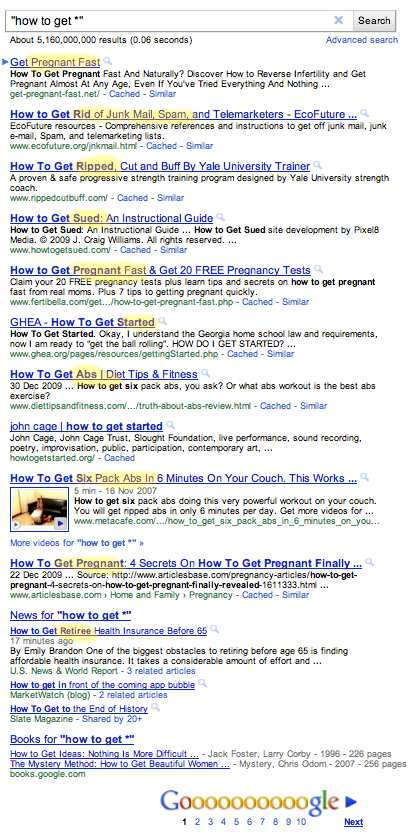
We’ve highlighted some of the blanks just from page one of Google:
how to get PREGNANT FAST

how to get RID OF JUNK MAIL AND SPAM

how to get SUED

how to get ABS

how to get SIX PACK ABS

how to get RETIREE HEALTH INSURANCE

how to get BEAUTIFUL WOMEN
Interesting, no?
A bit more digging on page two and three:
how to get TALLER

how to get BACKLINKS

how to get LATISSE

how to get TICKETS

how to get A GIRL

how to get PUBLISHED

how to get MARRIED

how to get PROMOTED

how to get A MORTGAGE

how to get WOMEN INTO BED
The sweet thing with this tactic is that it never runs out. Do this same search next month or the month after — and you’ll prob’ly see new/different results.
We call the first part of the question — the Seed-Question. The more of these Seed-Qs you come up with — the better your ability will be to find these hidden niche gold mines.
We’ll give you a few here to start off with. To get you going.
how to ___________
how to get ___________
how to lose ___________
how to become ___________
how to reduce ___________
how to improve ___________
how to remove ___________
how to jump ___________
how to cure ___________
how to get rid of ___________
how to stop ___________
where to buy ___________
where to buy ___________ online
where to buy ___________ for christmas
how to overcome ___________
how to master ___________
how to increase ___________
how to not ___________
how to make ___________
how to quit ___________
how to start ___________
how to learn ___________
Now … you want to stop and try to understand why someone would be searching Google for a potential solution.
This is critical.
Here are some questions you need to ask yourself when trying to identify your ideal target audience:
- Is the person experiencing pain, urgency, or irrational passion? (In other words … a strong emotion to seek out a solution?)
- Is there an audience proactively searching for solutions… and already spending money to satisfy this desire, want or need?
- From the prospect’s perspective, do they have few or no perceived options?
- Is there potential for a long term relationship with this audience? (Meaning … are there back-end options/opportunities?)
Point 4 is critical if your goal is to establish a long term relationship and make money from the same person, over and over again (over time).
For example — someone searching for a "cure sweating"solution prob’ly ticks the first three questions above. But fails Q4.
Cure their sweating problem and you’ve just lost that customer. Meaning — you can’t sell them other “stop sweating” info products, of course. Problem is already solved.
IM (internet marketing) on the other hand is the perfect niche that has very deep backend opportunities.
You can buy a paid traffic course. You can buy a course just on AdWords or Bing or Facebook.
You can buy a course on getting backlinks for free traffic.
You can buy info on copywriting.
Email writing.
Article writing.
You get it … two niches with very different backend opportunities.
Our recommendation to you would be to target a niche that gives you the ability to sell other stuff to your customers on an ongoing basis.
Repeat the Seed-Q tactic until you’ve come up with a list of interesting potential niches.
STEP 2: Niche Discovery
There are a few great places on the internet that are absolute gold mines for niche discovery.
These are two of our favorites:
1. Amazon
http://www.amazon.com/gp/bestsellers
http://www.amazon.com/gp/most-wished-for
Amazon is a gold mine with a HUGE database (close to 100 million items). Sweeeeeeet! 🙂
Now you can enable sorting by clicking on the Department link.
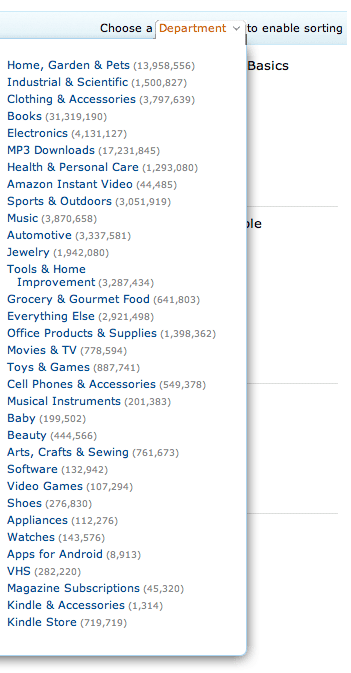
At the time of writing this — we see 444,566 items for Beauty. We’ve just clicked that (to demonstrate this in action)…
Now to the right is a drop-down box. Sort by Relevance is prob’ly selected by default. Play around with the filtering choices to find potential gold nuggets.
We’ve just sorted by Price: High to Low … and found this:
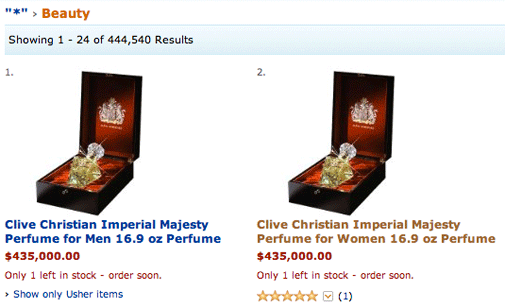
OMG! … $435,000.00
Notice that one of these items actually has a comment. Here it is…
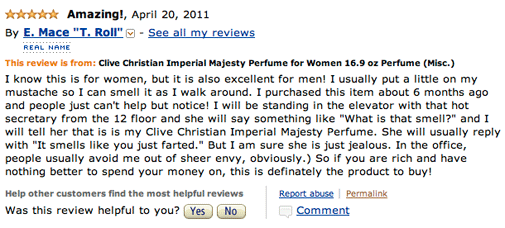
Brilliant!
That comment already tells me quite a bit about the guy that purchased it. He works in an office block. The perfume costs $435K. I presume he’s a CEO or someone close.
Love this part of the comment:
“So if you are rich and have nothing better to spend your money on, this is definitely the product to buy!”
Priceless!
UPDATE: Thanks to Greg McCurdy (one of our trainees) for bringing to our attention that the review (comments) for this item is a “joke”.
Apparently, it’s pretty common practice for super expensive products to write silly reviews. Go figure 🙂
Anyway … just keep this in mind when looking at reviews on expensive products. 999 times out of 1000 you’ll not have a problem “extracting” nuggets from normal products.
2. The ClickBank Marketplace
http://www.clickbank.com/marketplace.htm
Remember … you aren’t actually looking for a “product” to promote. You’re simply getting niche market ideas. Nothing else.
STEP 3: Validate Your 3 Chosen Hyper-Focused Niches
This is an important step you must do each time you decide on a potential market to target.
Very often a marketer will choose a niche based on the volume of potential traffic it can get, or because the crowd seems very keen to find a solution … but when it comes to making money out of that niche — it’s tough.
There are different reasons for that, but most often it’s because the people looking for the solution just aren’t willing to pay for it, for whatever reasons.
Needless to say — you’d rather know if a niche isn’t going to bring ROI right upfront … hence the validation exercise.
You need to validate if advertisers are spending money in this niche. If there’s a bunch of advertisers spending money — then you can almost safely presume that there’s money to be made.
Another good way to spot a potential dud is to see if there are a bunch (not just one stray one) of similar products already being sold in the market.
If there’s more than one product — it’s safe to assume (for now) there’s money to be made.
For now — you just want a quick validation test. Don’t get too caught up in this step.
Between now and the next task, you need to find a niche market that you are going to target.
Here’s a tip…
It’s always (bar none) better to learn by doing then it is to learn by just reading and/or watching.
Don’t get too hung up with choosing the perfect niche market if you still haven’t come to a definitive decision within a week.
Pick something — perfect or not — and we’ll use that to build out our first socila media campaign. Worse case scenario is that you don’t make a ton of money … but you’ll learn a ton.
The next campaign will then be better for it.
Now go take action and we’ll continue moving forward!